
Introduction
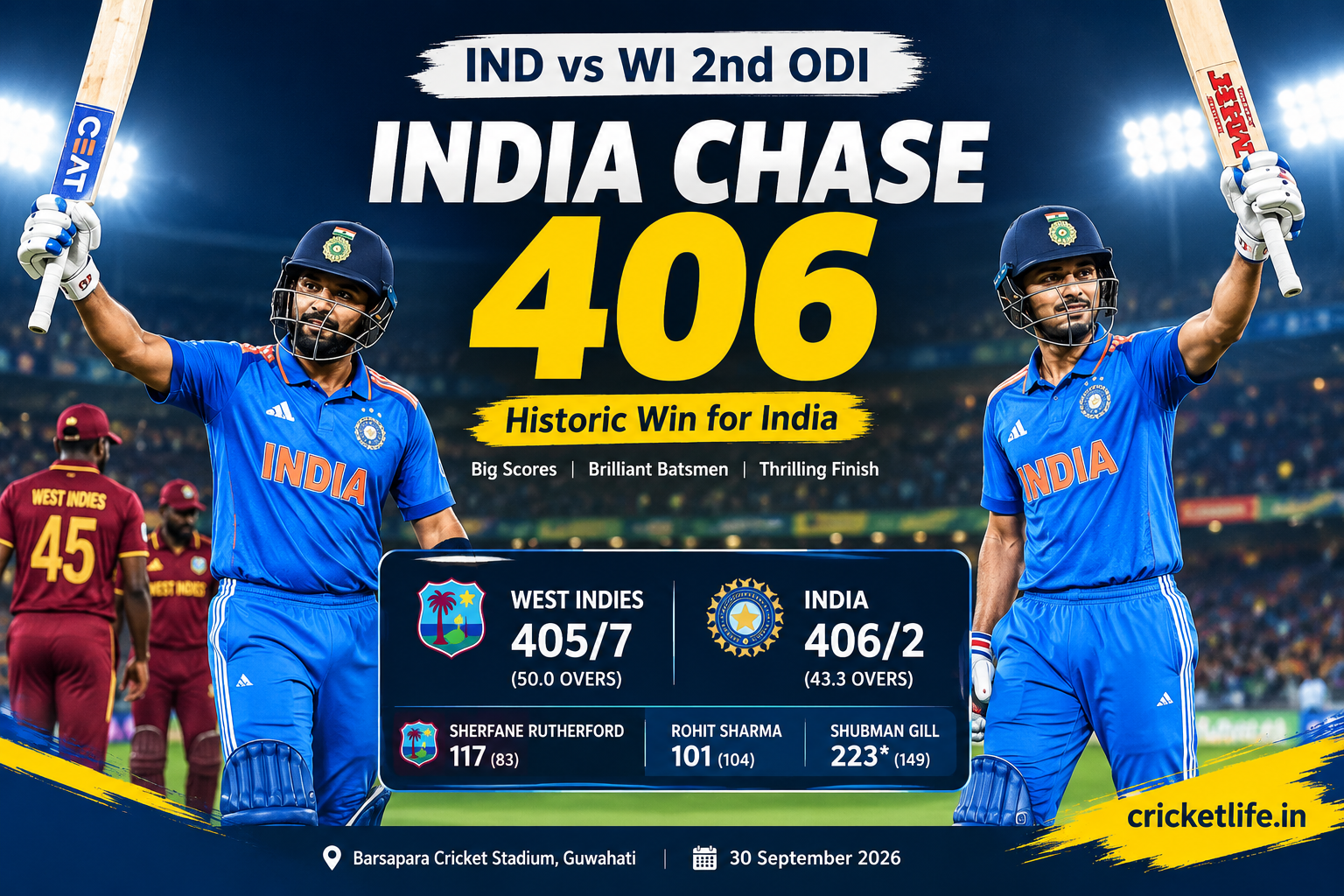
The year 2026 witnessed one of the maximum awesome batting performances within the shape of India vs West Indies 2nd ODI fit. After West Indies scored an large overall of 405 runs for 7 wickets in 50 overs, India become given a target of 406 runs. Having said that, the suit transformed into a notable run chase as Shubman Gill succeeded in scoring a double century, which allowed India to sign up a rating of 406 runs for two wickets in just forty three.3 overs.
There was no doubt that West Indies anticipated that the total of 405 runs would be sufficient. John Campbell, Shai Hope, and Amir Jangoo all scored 100s in this match, which marked for the first time that the total runs scored were above 400 in the ODI match. However, the response by India was indeed exceptional in chasing this target. Gill played well in the run chase while Rohit Sharma too managed to score 100.
West Indies Post 405/7 After Three Centuries
West Indies won the toss? No — India won the toss and elected to field first. The decision initially appeared risky because the West Indies batting line-up immediately put pressure on the Indian bowlers.
John Campbell started aggressively and made full use of the powerplay. He scored 101 from 68 balls, including nine fours and five sixes. His attacking approach gave West Indies the perfect start. The visitors reached 96/1 at the end of the first 10 overs.
Shai Hope then continued the momentum. He scored 104 from 94 balls and survived two dropped chances during his innings. His partnership with Campbell helped West Indies build a strong platform.
Amir Jangoo provided the biggest acceleration later in the innings. He smashed 114 from 77 balls, including 13 fours and three sixes. His innings ensured that West Indies remained on course for a total beyond 400.
As a result, West Indies finished with 405/7. It was their highest-ever ODI total and their first score above 400 in the format. Three West Indies batters scoring centuries in the same ODI innings was another major highlight.
India vs West Indies 2nd ODI 2026 Scorecard
West Indies – 405/7 in 50 Overs
| Batter | Runs | Balls |
| John Campbell | 101 | 68 |
| Shai Hope | 104 | 94 |
| Amir Jangoo | 114 | 77 |
| Sherfane Rutherford | 0 | 1 |
| Keemo Paul | 3 | 8 |
| Roston Chase | 29* | 25 |
| Shamar Joseph | 14* | 8 |
| Total | 405/7 | 50 overs |
India bowling: Kuldeep Yadav 2/65, Ravindra Jadeja 2/75, Gurnoor Brar 2/96. Auqib Nabi conceded 84 runs in 8.5 overs on debut.
India – 406/2 in 43.3 Overs
| Batter | Runs | Status |
| Rohit Sharma | 101 | Out |
| Virat Kohli | 45 | Out |
| Shubman Gill | 223* | Not out |
| Ruturaj Gaikwad | 31* | Not out |
| Total | 406/2 | 43.3 overs |
Result: India won by 8 wickets with 39 balls remaining. The final score and unbeaten contributions from Gill and Gaikwad are reflected in the post-match scorecard updates.
Shubman Gill Turns the Chase Into a Spectacle
The biggest story of the match was undoubtedly Shubman Gill.
Chasing 406 could have created enormous pressure on India’s top order. Instead, Gill attacked the target with remarkable confidence. He eventually finished unbeaten on 223 from 133 balls, with a strike rate of 167.67.
Gill did not simply stay at the crease. He controlled the tempo of the innings and continued to find boundaries even when the required rate was high. His innings combined clean hitting with excellent placement.
Most importantly, Gill’s approach meant that the required run rate never became a major problem for India. Once the opening partnership had settled, the pressure moved back towards the West Indies bowlers.
The significance of his double century can also be seen in the context of ODI cricket as Gill became just the second player to have achieved the feat after Rohit Sharma. In fact, he was the first batter to hit a double-century in just 117 deliveries, thereby making it the record for the fastest double century in ODI history at that point in time.
Rohit Sharma Provides the Perfect Start
Before Gill took complete control, Rohit Sharma played a crucial role.
Rohit scored 101 and gave India the attacking beginning required for such a demanding chase. Due to his potential to score quickly in the early stages, India was able to stay on track.
The combination of Rohit and Gill proved to be very crucial since they had to play aggressively but at the same time exercise caution to win the match by successfully chasing down 406. Once Rohit reached his century, the chase was already moving firmly in India’s favour. His contribution reduced the pressure on Gill and allowed the Indian captain to play with greater freedom.
What Went Right for India?
There were several positive aspects for India.
- Outstanding Opening Partnership
The opening stand gave India the platform they needed. Rohit and Gill attacked the West Indies bowlers while also keeping wickets in hand. - Gill’s Extraordinary Batting
Gill’s 223* was the defining performance of the match. His innings combined patience, timing and power. Once he reached his century, he became increasingly aggressive. - Strong Response to a Huge Target
India did not panic after seeing 405 on the scoreboard. Instead, the batters treated the chase as a batting opportunity. This mindset made a huge difference. - Experience Under Pressure
Rohit and Gill have considerable experience in ODI cricket. Their ability to read the situation helped India avoid an early collapse. - Finishing the Chase Early
India reached 406 with 39 balls still remaining. That showed how dominant the batting performance became after the initial stages.
Where Did India Struggle?
Although India won, their bowlers raised major concerns during the match.
The fact that West Indies obtained 405/7 indicates that the bowlers could not manage the proceedings in the majority of the first half of the innings. Gurnoor Brar was asked to deliver 10 overs to concede 96 runs, while debutant Auqib Nabi gave away 84 runs in 8.5 overs.
Moreover, in the initial Powerplay phase, West Indies reached 96/1 score. Campbell was in particular ruthless against the Indian bowlers, giving them little breathing space.
Kuldeep Yadav and Ravindra Jadeja were finally able to capture two wickets each. Kuldeep also achieved his first milestone of 200 ODI wickets during the innings, though overall bowling figures show that India was unable to exert pressure on the scoring rate.
Who Was Responsible for India’s Bowling Problems?
It would be unfair to blame one player alone because the West Indies batting unit played exceptionally well. Nevertheless, the figures clearly show where India lost control.
Gurnoor Brar’s 2/96 and Auqib Nabi’s 0/84 were expensive spells. The two bowlers allowed West Indies to maintain a high scoring rate, particularly during the powerplay and middle overs.
At the same time, the fielding also provided West Indies with opportunities. Shai Hope was dropped twice before reaching his century. Those missed chances increased the pressure on the bowlers.
Therefore, India’s main concern from this match is not the batting. The batting was outstanding. The bigger lesson is that the bowling unit needs greater consistency when opponents attack from the beginning.
West Indies’ Positives Despite the Defeat
West Indies should not overlook the positives from this match.
Scoring 405/7 against India was a major achievement. Campbell, Hope and Jangoo all scored centuries, showing the depth of their batting on a good pitch.
Campbell’s 101 provided early momentum, Hope’s 104 added stability, and Jangoo’s 114 supplied the acceleration. Together, they created an innings that looked capable of deciding the match.
However, the bowling attack could not defend the total. India’s top order made the difference after the innings break.
The Biggest Turning Point of the Match
The biggest turning point was India’s opening partnership.
When a team is chasing 406, early wickets can change the entire contest. West Indies needed breakthroughs during the powerplay. Instead, Rohit and Gill kept scoring.
Once India moved comfortably through the opening overs without losing wickets, the pressure increased on the West Indies bowlers.
The second major turning point was Gill crossing his century and continuing to attack. At that stage, India were no longer simply trying to survive the chase. They were taking control of it.
India vs West Indies 2nd ODI 2026: Key Takeaways
The India vs West Indies 2nd ODI 2026 will be remembered primarily for the extraordinary batting performances.
For India, Gill’s 223* was the central highlight. Rohit’s century provided the foundation, while Gaikwad stayed at the crease to help finish the chase.
For West Indies, the three centuries were a major positive. Campbell, Hope and Jangoo demonstrated that the team has the ability to challenge India’s bowling attack.
However, the difference between the teams came during the second innings. India converted a difficult 406-run target into a comfortable victory and finished the match with 39 balls remaining.
Final Verdict
The second ODI match between India and West Indies was a great display of the evolution of modern-day ODI batting in cricket. West Indies set a mammoth target of 405 runs, marking their highest score in an ODI inning and producing three centuries in the match. They would have been proud of their efforts normally, but on this day it was India who surpassed everything.
The most notable performance came from Shubman Gill, who scored an unbeaten 223, and Rohit Sharma chipped in with a hundred, helping India achieve that mammoth total. However, it should be noted that India has to sort out its bowling before heading to the next game in the series.
In the end, India won this high-scoring match by 8 wickets by scoring 406 runs for the loss of only two wickets in just 43.3 overs. Clearly, that was a great batting display from West Indies, but it was India that responded with an even better one.
For the cricket enthusiasts, this match was not just an ODI match; it became an extraordinary innings full of record scores, centuries, and an unbelievable chase that will be remembered for some time.
Leave a Reply