
Introduction: A High-Stakes Clash in Cardiff
The stadium located in Cardiff, popularly known as Sophia Gardens, hosted a really exciting part of the Indian tour to England in 2026. After the victory in Birmingham, the visitors were looking for more wins in the tournament. The buildup to the match was quite simple and interesting: Can India win the tournament with one match still to go?
The whole event started with the very first ball and continued almost as a modern-day match with all its tactics and intensity of play. With thousands of Indian travelers and local spectators in attendance, the home team managed to master a special bowling tactic and conclude the game successfully.
First Innings: The Indian Batting Script Stumbles
After winning the toss on a surface that promised initial assistance to the quicks before settling down, England put India in to bat. The strategy yielded immediate dividends. India’s powerhouse opening duo, Rohit Sharma and Shubman Gill, faced a relentless, hostile testing period against the new white ball. The English opening bowlers hit immaculate lengths, making the most of the crosswinds characteristic of Sophia Gardens.
The Top-Order Strangles:
As an aggressive player, Rohit Sharma’s performance was unexpected as he appeared restrained in the beginning of the inning. The English bowling line ensured that they were pacifying him with a series of short deliveries and bouncers. His struggle for a mere 26 runs in 47 balls demonstrated the efficiency of the English bowling attack. Among the other players, Shubman Gill was eliminated fairly early during the match.
The Kohli and Iyer Stabilization Act:
When India appeared to be in a precarious situation, experienced players like Virat Kohli along with Shreyas Iyer played a big role in getting India back into the game, bat well and turning the innings round. They knew the pitch well and managed to rotate the strike.
Virat Kohli delivered a solid innings of 65 full of superb cover drives and exquisite flicks, bringing the pressure back on the English spinners Richard Adil and Liam Livingstone. Meanwhile, Iyer was aggressive on his part, scoring well too and achieving a fine score of 66. Their partnership had set a great foundation for the Indian innings, but the English bowlers remained in the game and did not let anything get past them.
The Collapse Initiated by Atkinson and Archer:
As India appeared to be on the verge of producing a total of around 280 runs, England delivered their biggest blow. Gus Atkinson devastated the middle order with a stunning performance of middle-overs bowling and obtained bounce and variety that confused the well-set batsmen.
Then, Jofra Archer finished the job with a fiery spell of bowling that used pace and accurate yorkers to demolish the tail and ensured a dramatic collapse. Having been in a comfortable position beforehand, the visitors were bowled out for a poor total of 233, having batted for exactly 44 overs.
Second Innings: A Masterclass in Run Chasing
To defend a modest total of 233 against a strong English batting lineup, the Indian bowling attack needed to secure early wickets and maintain complete discipline.
Early Inroads Give India Hope:
Jasprit Bumrah and Mohammed Siraj started with great intensity. Bumrah, utilizing his unique release and subtle movement, asks questions with every delivery. India struck early breakthroughs, removing the dangerous English openers before they could cause catastrophic damage in the powerplay. The ball was moving, the field was sharp, and for a brief window, an Indian comeback seemed entirely plausible.
The Joe Root Show
Enter Joe Root. The legendary batsman stepped onto the pitch and completely dictated the tempo of the second innings. While the Indian bowlers tried to extract life from the deck, Root put on a clinic in anchoring an ODI chase. His footwork against both pace and the spin of Kuldeep Yadav was exemplary.
Root found a reliable ally in the explosive Harry Brook, and later in the lower-middle order, ensuring that the required run rate never escalated into dangerous territory. As the overs ticked by, Root systematically picked gaps, used the pace of the Indian quicks to pick up boundaries behind square, and single-handedly took the game away from the visitors.
The Heartbreaking 99 Not Out:
As the target drew near, the focus shifted from the match result to an individual milestone. Root was closing in on a well-deserved century. However, cricket can be a game of bizarre endings. With the target down to single digits, Gus Atkinson hit a flurry of quick runs at the other end.
With only a couple of runs needed for victory, Root found himself stranded on 99* off 133 deliveries. While he missed out on the personal milestone by a solitary run, his masterclass guided England to 235/6 in 44.1 overs, completing a clinical 4-wicket victory with 35 balls to spare.
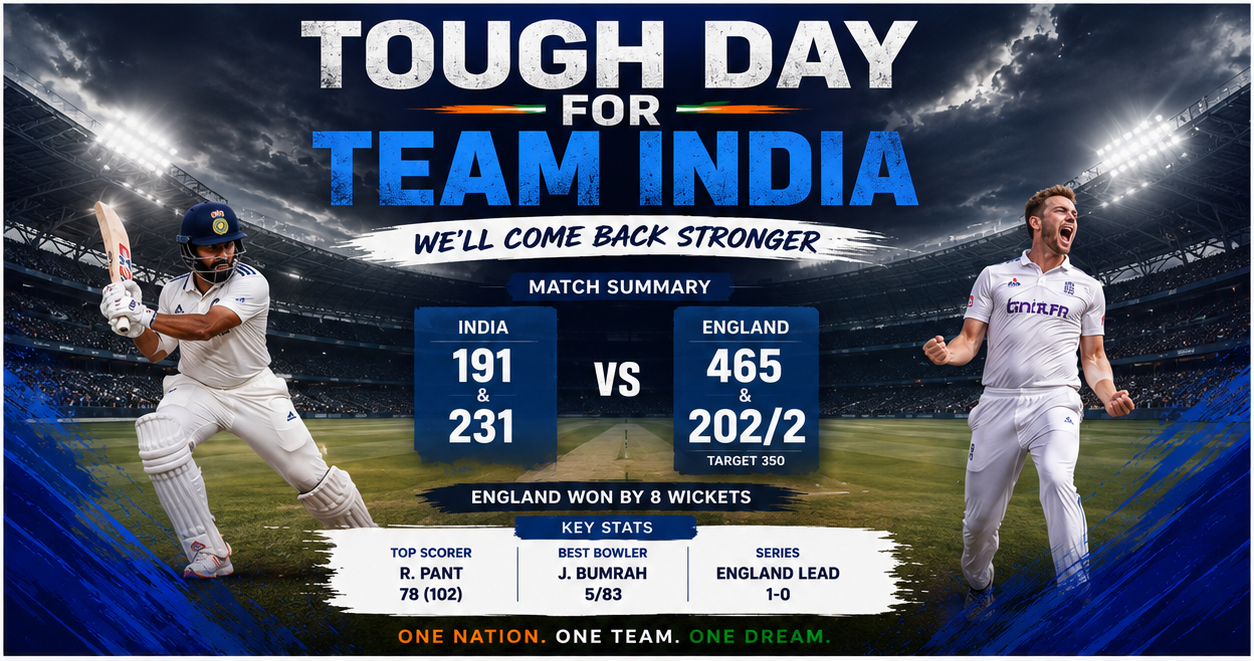
India Total All Out (44.0 overs) 233
England Innings (Target: 234 runs)
England to 235/6
Key Takeaways and Turning Points:
Analyzing how the match slipped away from India reveals several critical phases where the momentum permanently swung to the English camp:
- The Batting Slowdown in Powerplays: India’s cautious start proved costly. Scoring at under four runs an over during the initial field restrictions put immense pressure on the middle order, forcing risky stroke play later on.
- Clinical Death Bowling: England’s tactical decision to hold back overs of Archer and Atkinson worked flawlessly. Their ability to pick up wickets in clusters wiped out the Indian tail before they could unleash a final assault.
- Root’s Spun Web: The absolute refusal of Joe Root to give away cheap dot balls meant India could never build sustained pressure. Even when boundaries were hard to come by, Root’s elite running between the wickets kept the scoreboard ticking flawlessly.
Conclusion: All Eyes on the Lord’s Decider
This praised comeback on behalf of the home team shattered India’s hopes of winning the series with ease away from home. With the three-match ODI series tied at 1-1, the cricket community now looks ahead at the final showdown that is set to take place at the iconic Lord’s Cricket Ground. For India, this loss is a call to rethink their strategy as far as their top-order aggression and the ability of the lower line-up to cope with expert seam bowling. For England, this has given a big boost of morale since that shows that their period of transition has enough strength and creativity to handle the tough Indian team. One thing is clear— the ’FINAL” at the home of cricket shall be a magnificent show!
Leave a Reply